Inspection & Testing · Installation · Maintenance
Clean Agent Fire Suppression System Inspection & FM-200 Service
Server rooms, data centers, control rooms and labs — anywhere water cannot be used. We inspect and test clean agent systems to NFPA 2001.
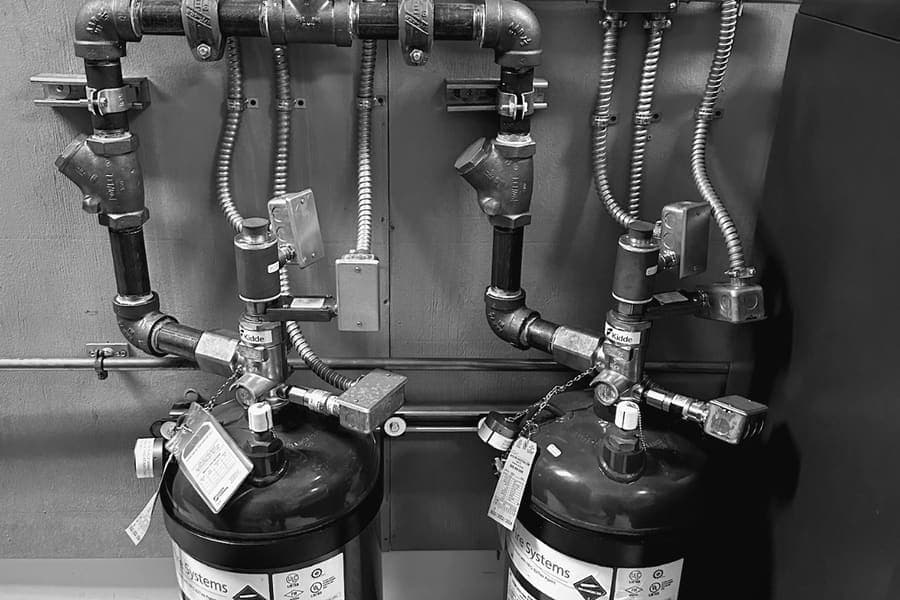
FM-200, CO₂, Halon and modern clean agents protect the equipment your business actually runs on. We weigh the cylinders, prove the release circuits, and test the one thing owners most often skip: whether the room can still hold the agent long enough to matter.
- Standards
- NFPA 2001 / NFPA 12 — Clean Agent & CO₂
- Agents
- FM-200, Novec, CO₂, legacy Halon
- Technicians
- NICET, Special Hazards Suppression
- Testing
- Cylinder weight, release circuits, room integrity
- Legacy systems
- Halon serviced and decommissioned properly
- Coverage
- NJ · PA · PHILA · DE
Core services
Inspection and testing, installation, maintenance.
We schedule inspections, installations and repairs around your working hours, so your operation keeps running.
Inspection & Testing
Semi-annual agent verification through the five-year door fan test — the full NFPA 2001 cycle.
- Agent quantity and container pressure verified semi-annually
- Detection, release and abort circuits functionally tested
- Full functional test with the solenoid isolated — no discharge
- Room integrity fan test on the five-year cycle
- Cylinder hydrostatic testing at 10 and 12 years
- Nameplate, hose and actuator condition documented
Installation & Upgrades
New protection for new data halls, and guidance on when a legacy system should be replaced.
- System design for server rooms, switch rooms and process equipment
- Releasing panels integrated with the building alarm
- Halon decommissioning and agent recovery, documented
- Selector valve and manifold work for multi-hazard coverage
- Abort and maintenance switch placement your staff can actually use
- Commissioning with the AHJ witness test
Maintenance & Recharge
After a discharge or a failed inspection, back in service fast — with the paperwork closed.
- Post-discharge recharge and requalification
- Cylinder replacement and requalification management
- Release solenoid and actuator replacement
- Detection cleaning in high-airflow environments
- Enclosure sealing remediation after cable pulls and renovations
- Emergency response around the clock
Common Questions
Clean Agent Suppression — questions we get asked.
How often does a clean agent system need to be inspected?
Semi-annual inspection with cylinder weight and pressure verification, annual system testing including the release circuit, and a five-year room integrity fan test on the enclosure. Hydrostatic testing of cylinders runs on its own longer cycle.
Why does the room need testing if the system is fine?
Clean agent works by holding a concentration in the room for a set hold time. If the enclosure leaks, the agent drains away before it does anything — so a perfectly healthy system in a leaky room is not protection. That is what the door fan test measures.
Can you service FM-200, CO₂ and Halon systems?
Yes — FM-200, CO₂, Halon and other clean agents, across data halls, switch rooms, control rooms and labs.
What happens after a discharge?
The system is out of service until it is recharged, so recharge is the priority. We also look for why it discharged before returning it to service.
We work on what's already in your riser room
No rip-and-replace pitch on the first visit. We hold current manuals and parts references for most systems above — when a system genuinely can't be maintained any longer, we'll show you why before we quote a replacement.
Clean Agent Fire Suppression System Inspection & FM-200 Service in trouble right now?
Call 1-888-306-8430 — the line is answered around the clock by a technician who can access your system information and start guidance on the phone.