
Inspection & Testing · Installation · Maintenance
Fire Alarm Monitoring
Fire alarm monitoring is what carries an alarm signal off your property to a central station that notifies the fire department. We install the monitoring, test the path, and confirm with the central station that the signal arrived.
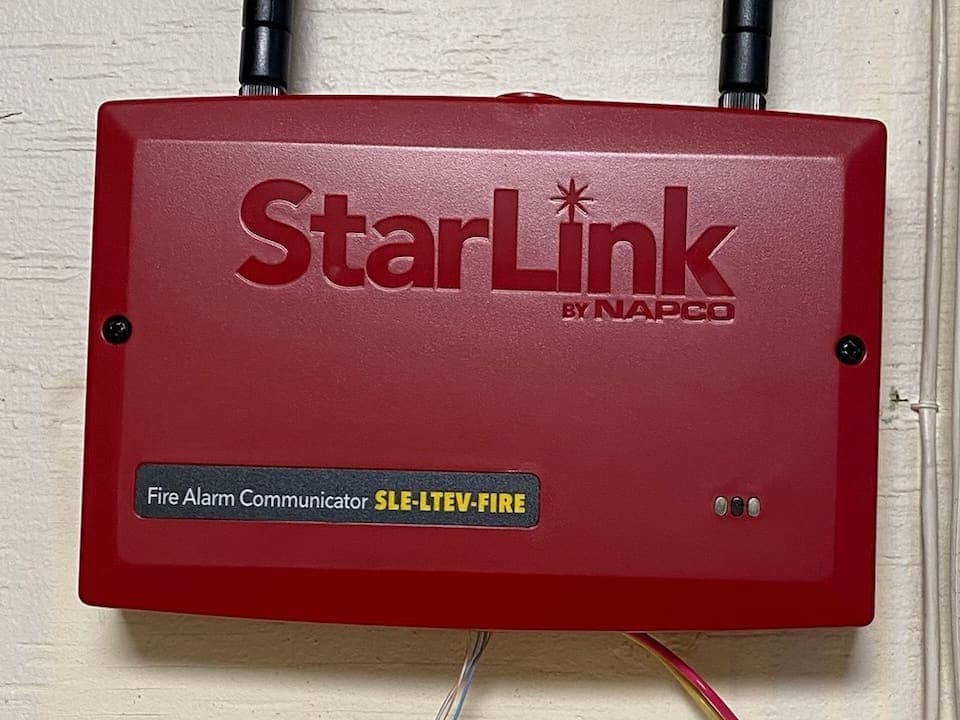
Your signals go to a UL-listed central station, staffed around the clock, with redundant facilities sharing the load. Cellular and IP communicators, dual-path radios, and the dialer lines still in service — alarm, supervisory and trouble tested separately.
- Standard
- NFPA 72 — National Fire Alarm and Signaling Code
- Central station
- UL-listed, staffed around the clock
- Paths
- Cellular, IP and dual-path communicators
- Signals
- Alarm, supervisory and trouble, verified separately
- Reporting
- Every signal sent and received, written down
- Coverage
- NJ · PA · PHILA · DE
Core services
Inspection and testing, installation, maintenance.
We keep the full service history on file, so when we need to visit for maintenance we already know your system.
Inspection & Testing
The annual test of the transmission path, with the central station on the phone confirming each signal as it lands.
- Alarm, supervisory and trouble transmitted and confirmed separately
- Both paths tested on a dual-path communicator, not just the primary
- Communicator supervision and signal strength checked and recorded
- Account information verified against what the central station holds
- Panel programming checked so each point reports as the right signal type
- Detailed report of every signal sent and every signal received
Installation
Communicators installed and commissioned, including the move off copper phone lines that carriers are retiring.
- Cellular and IP communicators on new and existing panels
- Dual-path installations where the code or the carrier requires two paths
- Replacement of dialers left stranded by phone line cutovers
- Waterflow, tamper and low-temperature points brought into supervision
- Fire pump and generator status monitored back to the panel
- Central station account set up and signal-tested before we leave the site
Maintenance & Troubleshooting
Communication troubles chased to the real cause — the carrier, the wiring, the programming or the account.
- Dialer and communicator trouble diagnosed rather than reset
- Runaway signals and repeat troubles traced to the device causing them
- Point descriptions corrected so a signal names the room it came from
- Account and call list kept current with the central station
- Path restored after a carrier change, panel swap or building renovation
- Emergency response around the clock
Common Questions
Fire Alarm Monitoring — questions we get asked.
Is fire alarm monitoring required for a commercial building?
It depends on the building, and it is decided by more than one party. Local code and your fire official set the baseline, and insurance carriers frequently require monitoring whether or not the code does. Buildings with a sprinkler system are the most common case — someone has to be told when water moves.
Who actually monitors the signal?
A UL-listed central station, staffed around the clock, with redundant facilities so a signal is never waiting on one building. They monitor on behalf of alarm companies and do not sell, install or own accounts, so your account stays with us and nobody watching your panel is selling you anything.
What happens when the fire alarm sends a signal?
The panel transmits to the central station, the operator identifies the account and the signal type, and they notify the fire department and then your call list. An alarm and a trouble signal produce very different responses, which is why each one is tested separately rather than assumed.
Our building still uses phone lines for the fire alarm. Do we have to change?
Eventually, and usually sooner than expected. Carriers are retiring copper, and buildings tend to find out when a line is cut over during an unrelated upgrade and the panel quietly stops delivering. A cellular or dual-path communicator replaces the dialer without replacing the panel in most cases.
Can you take over monitoring on a system someone else installed?
Usually yes, and usually without replacing the panel. The first step is to send a signal and find out what actually arrives, because a takeover on paper is not the same as a verified path. Contact us with the panel make and we can tell you what is involved.
We work on what's already in your riser room
No rip-and-replace pitch on the first visit. We hold current manuals and parts references for most systems above — when a system genuinely can't be maintained any longer, we'll show you why before we quote a replacement.
Fire Alarm Monitoring in trouble right now?
Call 1-888-306-8430 — the line is answered around the clock by a technician who can access your system information and start guidance on the phone.